7kW Solar System Price in Pakistan 2026: Real Costs, Financing & What Actually Runs
If you’ve spent any time collecting quotes for a 7kW solar system, you’ve probably ended up more confused than when you started. One vendor quotes Rs. 780,000. Another quotes Rs. 2.2 million. Both call it “7kW.” Neither explains why the numbers are so far apart, and after your third or fourth call to a solar dealer, it starts to feel like nobody’s giving you a straight answer.
There’s a reason for the gap, and it’s not that someone’s lying to you. This guide walks through exactly what drives a 7kW system’s price in Pakistan, what a realistic budget looks like depending on what you actually need, how to avoid the mistakes that cost other buyers the most money, and how to finance it if you can’t pay the full amount upfront.
How Much Does a 7kW Solar System Cost in Pakistan? (Quick Answer)
A complete, professionally installed 7kW solar system in Pakistan costs between Rs. 780,000 and Rs. 1,550,000, depending on whether you choose on-grid or hybrid, and lead-acid or lithium batteries. Off-grid systems, which need a much larger battery bank to cover your full nighttime load, run higher — typically Rs. 1,400,000 and up.
| System Type | Battery | Installed Cost (PKR) |
| On-grid (no battery) | None | 780,000 – 980,000 |
| Hybrid | Lead-acid / tubular | 950,000 – 1,300,000 |
| Hybrid | Lithium (LiFePO4) | 1,200,000 – 1,550,000 |
| Off-grid | Lithium, sized for full load | 1,400,000 – 2,200,000+ |
A 7kW system generates roughly 28–38 units of electricity per day in Pakistan’s climate, enough to substantially offset — or in many cases eliminate — a monthly bill in the Rs. 55,000–100,000 range.
Price Breakdown Table
| Item Details | Price |
| Jinko N type 580 watt bifacial solar panels (12) | 215000 |
| Inverter Solis 7kW 4G on-grid solar Inverter | 174000 |
| Installation Cost | 27840 |
| Structure L 2 (6) | 30000 |
| Protection Complete DP Box | 45000 |
| NET METERING | 170000 |
| DC Cables 6mm Coil | 12000 |
| Total Estimated | 675000 |
7kW Solar System Cost Estimator (calculator)
🔍 Comparison: 5kW vs 7kW vs 10kW Solar Systems
| Feature | 5kW System | 7kW System | 10kW System |
|---|---|---|---|
| Estimated Cost | Rs. 05-06 Lakhs | Rs. 06-07 Lakhs | Rs. 10-11 Lakhs |
| Required Space | 400–450 sq. ft | 550–600 sq. ft | 800–900 sq. ft |
| Panel Count (580W) | ~9 Panels | ~12 Panels | ~17 Panels |
| Inverter Size | 5kW On-Grid / Hybrid | 7kW On-Grid / Hybrid | 10kW On-Grid / Hybrid |
| Net Metering | Recommended | Highly Recommended | Essential |
| Battery Option | Optional (small backup) | Optional / Medium backup possible | Recommended for large backup use |
| Ideal For | 1 AC, Fans, Lights, Fridge | 2 ACs, Washing Machine, etc. | Large Homes, Offices, Shops |
| Payback Period | 3.5 – 4 years | 3 – 3.5 years | 2.5 – 3 years |
Why 7kW Quotes Range From Rs. 780,000 to Rs. 2.2 Million
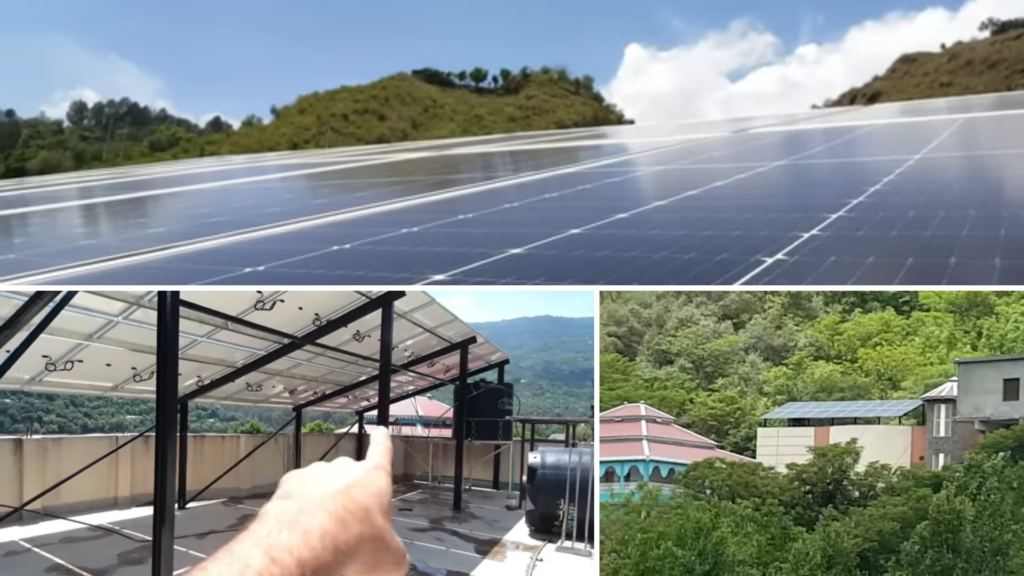
This is the question that actually matters more than any single price figure, and almost nobody answers it directly. Three variables account for nearly the entire spread:
1. On-grid vs. hybrid vs. off-grid.
An on-grid system with no battery is the cheapest, because you’re only paying for panels, inverter, and installation — the grid itself acts as your “battery” during the day. A hybrid system adds a battery bank for evening use and outage backup, which is where most of the price jump happens. An off-grid system removes the grid entirely from the equation, so the battery has to be sized for your entire nightly load, not just supplement it — that’s why off-grid quotes run highest.
2. Battery chemistry.
Lead-acid (tubular) batteries are cheaper upfront but need replacing every 3–5 years and shouldn’t be discharged past roughly 50% without shortening their life further. Lithium (LiFePO4) batteries cost more initially but last 8–10+ years and can be safely used down to 80–90% of capacity — meaning you get more usable storage from a similarly rated battery. Two “7kW hybrid” quotes with a Rs. 300,000 gap between them are very often just this difference.
3. What’s bundled vs. quoted separately.
Some vendors fold net metering/net billing paperwork (smart meter, DISCO processing, certification — typically Rs. 100,000–200,000) into the headline price. Others quote it separately and only mention it once you ask. Neither approach is wrong, but comparing a bundled quote against an unbundled one without adjusting for this makes an apples-to-apples comparison impossible.
Practical takeaway:
when you get a quote, ask specifically which of these three variables it assumes. A vendor who can’t answer immediately probably hasn’t thought it through either.
If you’ve spent any time collecting quotes for a 7kW solar system, you’ve probably ended up more confused than when you started. One vendor quotes Rs. 780,000. Another quotes Rs. 2.2 million. Both call it “7kW.” Neither explains why the numbers are so far apart, and after your third or fourth call to a solar dealer, it starts to feel like nobody’s giving you a straight answer.
There’s a reason for the gap, and it’s not that someone’s lying to you. This guide walks through exactly what drives a 7kW system’s price in Pakistan, what a realistic budget looks like depending on what you actually need, how to avoid the mistakes that cost other buyers the most money, and how to finance it if you can’t pay the full amount upfront.
How Much Does a 7kW Solar System Cost in Pakistan?
A complete, professionally installed 7kW solar system in Pakistan costs between Rs. 780,000 and Rs. 1,550,000, depending on whether you choose on-grid or hybrid, and lead-acid or lithium batteries. Off-grid systems, which need a much larger battery bank to cover your full nighttime load, run higher — typically Rs. 1,400,000 and up.
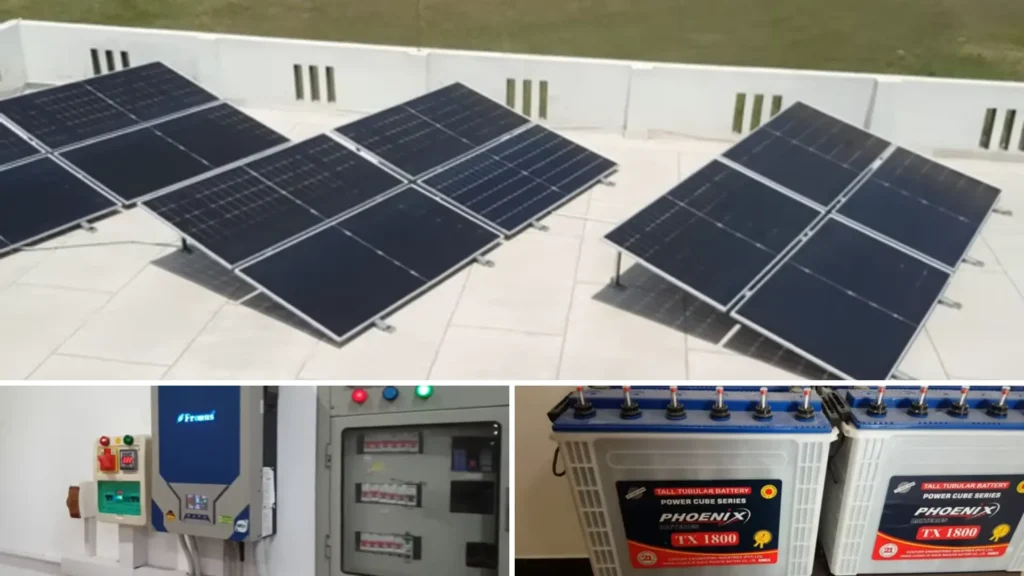
| System Type | Battery | Installed Cost (PKR) |
|---|---|---|
| On-grid (no battery) | None | 780,000 – 980,000 |
| Hybrid | Lead-acid / tubular | 950,000 – 1,300,000 |
| Hybrid | Lithium (LiFePO4) | 1,200,000 – 1,550,000 |
| Off-grid | Lithium, sized for full load | 1,400,000 – 2,200,000+ |
A 7kW system generates roughly 28–38 units of electricity per day in Pakistan’s climate, enough to substantially offset — or in many cases eliminate — a monthly bill in the Rs. 55,000–100,000 range.
Why 7kW Quotes Range From Rs. 780,000 to Rs. 2.2 Million
This is the question that actually matters more than any single price figure, and almost nobody answers it directly. Three variables account for nearly the entire spread:
1. On-grid vs. hybrid vs. off-grid. An on-grid system with no battery is the cheapest, because you’re only paying for panels, inverter, and installation — the grid itself acts as your “battery” during the day. A hybrid system adds a battery bank for evening use and outage backup, which is where most of the price jump happens. An off-grid system removes the grid entirely from the equation, so the battery has to be sized for your entire nightly load, not just supplement it — that’s why off-grid quotes run highest.
2. Battery chemistry. Lead-acid (tubular) batteries are cheaper upfront but need replacing every 3–5 years and shouldn’t be discharged past roughly 50% without shortening their life further. Lithium (LiFePO4) batteries cost more initially but last 8–10+ years and can be safely used down to 80–90% of capacity — meaning you get more usable storage from a similarly rated battery. Two “7kW hybrid” quotes with a Rs. 300,000 gap between them are very often just this difference.
3. What’s bundled vs. quoted separately. Some vendors fold net metering/net billing paperwork (smart meter, DISCO processing, certification — typically Rs. 100,000–200,000) into the headline price. Others quote it separately and only mention it once you ask. Neither approach is wrong, but comparing a bundled quote against an unbundled one without adjusting for this makes an apples-to-apples comparison impossible.
Practical takeaway: when you get a quote, ask specifically which of these three variables it assumes. A vendor who can’t answer immediately probably hasn’t thought it through either.
Full Cost Breakdown: What You’re Actually Paying For
| Component | Typical Spec | Estimated Cost (PKR) |
|---|---|---|
| Solar panels | 12–13 panels × 580W, N-type TOPCon (LONGi, Jinko, Canadian Solar) | 330,000 – 420,000 |
| Hybrid/on-grid inverter | 7–8kW rated (Growatt, Deye, Sungrow, GoodWe) | 240,000 – 350,000 |
| Battery (hybrid systems only) | 8–10kWh lithium, or lead-acid equivalent | 160,000 – 420,000 |
| Mounting structure & balance of system | Galvanized structure, DC cabling, protection devices | 70,000 – 110,000 |
| Elevated/uplift structure (if needed) | For shaded roofs, multi-story buildings, or dust-heavy areas | +90,000 – 110,000 |
| Installation & commissioning | Labor, wiring, testing | 55,000 – 85,000 |
| Net metering / net billing application | Bi-directional smart meter, DISCO fees, certification | 100,000 – 200,000 |
The elevated structure cost catches a lot of buyers off guard. If your roof has shading, uneven surfaces, or you’re on a multi-story building where panels need to sit higher for sun exposure, budget for this separately — it’s rarely mentioned upfront in ballpark quotes.
Panel cost alone is typically only 35–45% of total system price. That’s worth remembering when a vendor tries to sell you purely on “price per watt of panels” — the inverter, battery, and protection equipment make up more than half your bill, and that’s where quality and price both vary the most.
Why “7kW” Doesn’t Always Mean 7kW
This is the complaint that comes up most often among Pakistani solar buyers, and it’s worth taking seriously before you sign anything.
Some vendors advertise a “7kW system” built from 14 panels rated at 450W each — which adds up to only 6.3kW of real panel capacity, often paired with an undersized inverter to match. It looks like a competitive price right up until you realize you paid 7kW money for 6.3kW of actual output.
Multiply the panel count by the per-panel wattage yourself. It should genuinely equal 7,000W. If a vendor’s number doesn’t match their “7kW” label, ask them to explain the difference in writing before you proceed.
A related and more expensive problem: an estimated 68%+ of buyer complaints in Pakistan’s solar market involve mismatched specifications or components quietly omitted from the final installation — a missing surge protection device, an undersized DC breaker, or a battery with fewer real charge cycles than advertised. The fix is the same in every case: get the exact datasheet for the model being quoted, not just a wattage number on a WhatsApp message.
5-Point Checklist Before You Sign Anything
- Panel datasheet match — request the PDF spec sheet for the exact model quoted, and confirm Voc, Vmp, Isc, and NOCT figures match the invoice, not just the headline wattage.
- Inverter voltage window — the inverter’s maximum PV input voltage should sit comfortably above your panel string’s Voc at low temperatures. An undersized window causes power clipping and can quietly cost you 8–12% of your yield.
- Battery depth-of-discharge (DoD) rating — lead-acid batteries should stay under roughly 50% DoD for reasonable lifespan; lithium can safely go to 80–90%. If a quote doesn’t specify DoD, ask directly.
- Protection equipment named individually — surge protection device (SPD), DC circuit breaker, AC circuit breaker, and isolator should each appear as their own line item, not buried inside a vague “installation” charge.
- Certification — confirm IEC 62116 (anti-islanding protection) and UL 1741 compliance if you plan to apply for net metering or net billing. Missing certification is one of the most common reasons DISCOs reject applications outright.
The Cost of Skipping Protection Equipment
Pakistan’s grid isn’t gentle on electronics. Voltage swings between 160–250V are common, load-shedding reconnection creates its own transients, and monsoon lightning adds real surge risk on top of both. Budget installers sometimes skip surge protection devices entirely to shave a small amount off the quote — and it’s consistently one of the most expensive mistakes to discover later. A damaged inverter can cost Rs. 200,000–500,000 to replace, against protection equipment that typically adds only 5–8% to total system cost. It’s inexpensive insurance against the single most common and costly failure mode in Pakistani rooftop installations.
One more thing worth knowing: panels bought without proper import documentation sometimes carry counterfeit or unregistered serial numbers. If something fails, the manufacturer won’t honor a warranty claim on a serial number they don’t recognize — regardless of what brand name is printed on the panel. Buy only through an authorized distributor and keep your invoice.
What Can a 7kW System Actually Run?
| Load | Typical Draw | Handled by 7kW? |
|---|---|---|
| 20× LED lights + fans | ~500W | Yes |
| No-frost refrigerator | ~180W | Yes |
| TV, laptop, phone chargers | ~200W | Yes |
| 2× 1-ton inverter AC | ~1,800W | Yes, simultaneously |
| 1× 1.5-ton inverter AC | ~1,400W | Yes, alongside the above |
| 1× 2-ton inverter AC | ~2,200W | Yes, with other loads reduced |
| Electric geyser (2kW) | ~2,000W | Only briefly, during peak solar hours |
In practice, a 7kW system comfortably handles two 1-ton inverter ACs running together plus all normal household loads. A third AC is workable if all three units are efficient inverter models drawing under roughly 800W each, but running three ACs and a geyser simultaneously will exceed what 7kW can deliver. If that’s your household’s regular usage pattern, size up to 8–10kW rather than trying to stretch a 7kW system past its limits.
6kW vs. 7kW vs. 8kW: Which Size Actually Fits?
- 6kW suits homes running two 1-ton ACs with standard loads, and a monthly bill around Rs. 40,000–60,000.
- 7kW fits homes running 2–3 ACs — especially a mix that includes a 1.5-ton or 2-ton unit — with a bill in the Rs. 55,000–100,000 range, where a full 8kW system would be more capacity than needed.
- 8–10kW makes sense if you consistently run three or more ACs at once, or have a geyser and water pump on the same circuit as your AC load.
The typical price gap between 7kW and 8kW is Rs. 150,000–200,000 — a worthwhile jump only if you’ll genuinely use the extra headroom rather than pay for capacity that sits idle.
Financing a 7kW System: Installment Options in Pakistan (2026)
Cost is the single biggest reason people delay going solar — not roof space, not paperwork. If your monthly electricity bill already sits at Rs. 55,000 or more, you’re effectively already paying for a solar system every month; financing simply redirects that payment toward something you’ll own outright instead of a bill that never ends.
Meezan Bank Solar Financing is the most established Shariah-compliant option, structured as Musawamah (an Islamic sale-based financing model rather than an interest loan). The profit rate is 1-Year KIBOR + 2.5% for salaried and pension-income applicants, or KIBOR + 3.5% for non-salaried applicants, with financing tenure from 12 to 60 months and typical down payments of 20–30% of system cost. It’s available for systems from 1kW up to 1000kW, though branch-level processing is concentrated in Karachi, Lahore, Islamabad, and Rawalpindi.
Bank Alfalah’s Green Energy financing, structured under the State Bank of Pakistan’s concessional renewable-energy scheme, offers a markup around 6% — meaningfully cheaper than standard bank rates — but eligibility and financing ceilings differ from conventional personal loans, so confirm current terms directly with the bank.
Faysal Bank offers a comparable fully Islamic alternative to Meezan with somewhat more flexible documentation requirements, worth comparing if your profit-rate sensitivity is high.
HBL, UBL, and other conventional lenders offer solar-specific or general personal-loan products, typically at higher markup rates (high-teens to mid-20s percent) than the SBP concessional scheme, but with wider eligibility and faster processing for buyers who don’t need Shariah compliance specifically.
A practical note on the process: every bank requires a formal written quotation from your installer before it will process a solar financing application — the loan amount is set by that quote, not the other way around. Size your system first, get the itemized quotation, then approach the bank.
Net Metering Changed in 2026 — What It Means for Your Payback
If part of your reasoning for going solar includes selling surplus electricity back to the grid, this policy shift matters more than almost anything else in this guide.
Under NEPRA’s Prosumer Regulations 2026, Pakistan replaced the old one-for-one net metering model with net billing for new applicants. Under the previous system, every unit you exported canceled one unit you imported — simple and generous. Under net billing, exported electricity is credited at roughly Rs. 8–13 per unit, while electricity imported from the grid still costs Rs. 40–68 per unit depending on your consumption slab. That’s not a small adjustment — it’s a genuine multiple, and it’s why installers across the market now recommend self-consumption-focused hybrid systems over export-heavy on-grid setups.
What this means practically for a 7kW buyer:
- A hybrid system with battery storage now clearly outperforms an export-focused on-grid system for most households, because using your own solar power in the evening is worth far more than selling it cheaply during the day and buying it back later at 4–6x the price.
- Existing net metering customers are grandfathered at their original one-for-one rate until their agreement expires; only new applicants fall under net billing.
- Net metering/billing still requires a 3-phase electrical connection and a minimum 5kW system size — a 7kW system meets this without issue.
- Budget Rs. 100,000–200,000 separately for the application itself: the bi-directional smart meter, DISCO processing fees, and installer certification. Approval typically takes 4–12 weeks depending on your DISCO.
Realistic ROI on a 7kW System in 2026
At roughly 32 units/day average generation and Rs. 35/unit in blended savings from self-consumption, a 7kW system saves approximately Rs. 33,000–34,000 per month. Against a fully-specified system cost of Rs. 1,000,000–1,300,000, that puts payback around 30–40 months, though your actual figure depends heavily on how much generation you self-consume versus export at the lower net billing rate. A hybrid system genuinely designed around self-consumption will consistently beat this estimate; a system still designed around old export assumptions will fall short of it.
Regional Notes
Pricing and financing access both shift somewhat by city. Karachi residents typically have more Islamic-banking financing options to choose from (Meezan, Faysal, Dubai Islamic all active), while Meezan’s disbursement volume skews toward Punjab and Khyber Pakhtunkhwa, where Shariah-compliant financing demand is highest. Installation costs themselves don’t vary dramatically city to city, but roof type — flat versus sloped, shaded versus open — affects whether you’ll need the elevated structure add-on covered earlier, and that’s often a bigger regional cost driver than the city itself.
Common Installer Red Flags
- A single lump-sum quote, with no itemization — makes it impossible to compare against other quotes or confirm you’re getting what you paid for.
- No mention of DoD, cycle life, or degradation rate for the battery — a vague “lithium battery” line without specs is worth questioning.
- No SPD or surge protection listed separately — the cheapest corner to cut, and the most expensive one to regret.
- No authorized distributor documentation for the panels — grey-market panels void warranties even under a legitimate brand name.
- Vague answers on net metering/billing timelines — a reputable installer should know your DISCO’s typical approval timeline and current buyback rate without hesitation.
Frequently Asked Questions
How much does a 7kW solar system cost in Pakistan in 2026?
A complete, professionally installed 7kW system costs Rs. 780,000–980,000 for on-grid, Rs. 950,000–1,550,000 for hybrid depending on battery type, and Rs. 1,400,000+ for off-grid — including panels, inverter, mounting, protection equipment, and installation labor.
What is the price of solar panels alone in Pakistan in 2026?
Solar panels alone cost roughly Rs. 24–48 per watt depending on brand and technology, meaning panel cost for a 7kW array runs approximately Rs. 330,000–420,000. This is separate from — and typically only 35–45% of — the full installed system price.
How much will an 8kW solar system cost in Pakistan in 2026?
An 8kW system typically costs Rs. 150,000–200,000 more than an equivalent 7kW setup, reflecting the larger panel array and higher-rated inverter needed for the extra capacity.
How many ACs can a 7kW solar system run?
Comfortably two 1-ton inverter ACs running simultaneously, alongside standard household loads like lights, fans, a refrigerator, and a TV. A third AC is workable only if all units are efficient, low-draw inverter models with other loads reduced.
Should I choose 6kW, 7kW, or 8kW?
Choose 7kW if you run 2–3 ACs with a monthly bill of Rs. 55,000–100,000. Go smaller if you only run two 1-ton ACs; go larger if you consistently run three or more ACs plus a geyser or water pump.
Can I get a 7kW solar system on installments in Pakistan?
Yes. Meezan Bank offers Shariah-compliant financing (Musawamah structure, KIBOR + 2.5–3.5%, 12–60 month tenure), Bank Alfalah offers a lower-markup option under the State Bank’s concessional renewable-energy scheme, and conventional lenders like HBL and UBL offer solar-eligible personal loans at higher rates. A written installer quotation is required before any bank will process the application.
Is net metering still worth it for a 7kW system in 2026?
Net metering itself has been replaced by net billing for new applicants, with export rates now well below import rates. A 7kW system remains a strong investment, but the savings now come primarily from self-consumption — using your own generated power instead of buying from the grid — rather than from selling surplus back at the old, more generous rates.
How do I avoid getting an undersized system sold to me as “7kW”?
Request the exact panel count and per-panel wattage in writing, and confirm the inverter’s rated capacity matches. Multiply panels × wattage yourself — it should genuinely equal 7,000W, not a smaller real capacity dressed up as 7kW in marketing copy.
Do grey-market solar panels really void my warranty?
Yes. If a panel’s serial number isn’t registered with the manufacturer through an authorized distributor, the manufacturer has no obligation to honor a warranty claim, regardless of the brand printed on the panel. Buy only through certified distributors and retain your invoice.